Bedford School Homepage Our Latest Field Trip Blogs Follow Us On Twitter Read The Bedford Geographical Newspaper Follow The Global Issues Blog by our A2 Students
Showing posts with label GCSE. Show all posts

Thursday, 6 February 2014

Modern Slavery

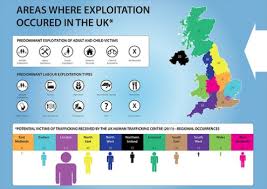
Y11 students Charlie, Phil, Sam, Arjun, James, Jack and Ollie have set up the research hub below about slavery linking to their study of migration in the GCSE population topic.

Important Facts
  • Official figures on the scale of the problem come from the UK Human Trafficking Centre, part of the National Crime Agency.
  • In 2012, it identified 2,255 potential victims of human trafficking - an increase of 178 (9%) on 2011, according to its report.
  • Of these potential victims, 778 were either found to have been trafficked or were awaiting a conclusive decision on their status. Of the 778 potential victims, 402 people - or 52% - were found to have been trafficked.
  • The top five nationalities of those identified were Romanian, Polish, Nigerian, Vietnamese and Hungarian.
  • Some 71% of the potential victims were adults, while 24% were children. The age of 99 potential victims was unknown.
  • The two most prevalent types of exploitation reported were sexual exploitation, which accounted for 35% of the potential victims, followed by labour exploitation (23%).
  • Of the potential child victims, 28% reported being sexually exploited, and 24% reported criminal exploitation.
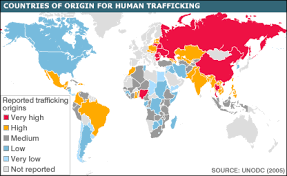
  •   Estimates indicate that at least 27 million people, in places such as Nigeria, Indonesia and Brazil are part of some sort of slavery.
  • The total number of people in debt bondage around the world was about 20 million in 1998.
  • The number of children in bonded labour in India alone was at 15 million at the end of the 20th century.
  • More than 1,000 women were trafficked into the UK for sexual purposes (mainly from Eastern and Central Europe).
  •  There are at least 5,000 child sex workers in the UK, most trafficked into the country.
  •  Worldwide, it is estimated that more than 12 million people may be working as slaves and of these; approximately 43 per cent are trafficked into sexual exploitation.
  • The worldwide traffic in human beings is worth at least US$32 billion annually.
  •   In 2004, 218 million children were trapped in child labour worldwide
  • 100,000 – 800,000 people are trafficked into the EU each year
  • There are at least 5,000 trafficking victims in the UK
  •  About 8,000 women work in off-street prostitution in London alone, 80% of them are foreign nationals
  • Over 1000 women trafficked into prostitution have been referred to the Poppy Project since March 2003
  •  200-300 victims of trafficking for domestic labour register with the relevant NGO each year
  •  It is estimated 330 child victims will be trafficked into the UK each year
  • About 60% of suspected child victims in local authority care go missing and are not subsequently found
  • There is long-term government funding for 35 places for victims in safe accommodation
  • 92 people were convicted of sex trafficking and four for labour trafficking between 2004 and December 2008
  • There are only 100-300 prosecutions for trafficking across the EU each year
  •  Each sex trafficker earns on average £500-£1000 per woman per week
 Sources:


Useful Links:

The link below is to a useful website that includes a defintions of slavery and traffiking, explains what happens to the forced workers and includes a factual passage by previous slaves.


An article by the BBC from three days ago stating that offical numbers on the amount of slaves in Wales are just estimates. Also the increase in plans to raise awarness of slavery.

This article from the BBC shows recent, shocking statistics for human trafficking and how it is growing at an alarming rate. It clearly illustrates the scale of human trafficking in the UK and how it is incredibly difficult to prevent it from happening

This video helps people realise what human trafficking is really about and the consequences if you don’t prevent it. It is very effective in keeping you alert about what actually happens in the UK and how you can prevent it from continuing. Not only does it raise awareness, it encourages you to get involved in prevention and to notice where trafficking occurs.

The article sums up what human trafficking is and gives named examples of recent events that have occurred. Information provided also raises awareness of trafficking, including place specifics and stats.

There is evidence of thousands of children working in the sex trade. For example there is a young Romanian girl who had a very tough life at the start when was given the opportunity to find work in the UK in a restaurant but her story got worse as she arrived in the UK. http://news.bbc.co.uk/1/hi/england/6224151.stm
It is estimated that 85% of brothel workers are from overseas forced into it.
  http://news.bbc.co.uk/1/hi/england/6459369.stm this is a link to a horrific story about sex slaves being held in the UK against there will.

Other Sources

InfoGraphics
h


Friday, 24 January 2014

Year 10 Assesment of the UK Floods

10o1-GG2 have researched why the UK flooded before Christmas. Two interesting pieces of work on it are below as promised!!! Read and enjoy. (click on an image to make it larger)


Thursday, 3 October 2013

Quality Y10 Tectonics Vids

Mr Strachan's Y10 class have been making videos about plate tectonics. See the examples below:

Could you do the same?

R.Sanghera


Toby

Wednesday, 25 September 2013

Pakistan Earthquake

Below is a storify of various sources showing the causes, effects and responses to the earthquake in Pakisatn on tuesday the 24th of September:

Monday, 21 January 2013

Solving Global Water Problems

Year 10 pupils were set a task to research global water supply issues and attempt to solve them. Two excellent offerings are below:

Wednesday, 2 January 2013

Kyoto Protocol: Excellent Intro

The video below from Canada's CBC network gives an excellent introduction to the Kyoto protocol and how Canada and other countries have followed it up. The article it is taken from is a must read to add facts and figures to the picture presented by the video.

Wednesday, 12 December 2012

Singapore Population Policies

Excellent overview below created by D. Frossell. Click the image to see a larger version.


Tuesday, 20 November 2012

Venice Floods Case Study

Year 12 D1 had the task to create a case study on the Venice floods in a single lesson. 4 methods were used: Prezi, Storify, Powerpoint and the classic: Word. The powerpoint group were the winners on this occasion as voted by MG and year 9 boys. The other 3 presentations were also very good but hey, win some and lose some!


Thursday, 15 November 2012

Sustainability Explained

Another excellent video to promote discussion about sustainability. Are these the only aims of sustainability? Do they go too far? is this achievable?

Wednesday, 14 November 2012

Great Extension on development and Population

Hans Rosling gives a 4 minute lesson on 200 years if history for 200 countries. Shows change in life expectancy along with wealth.

Monday, 22 October 2012

Amazing video of Japanese Earthquake


The video below gives an outstanding view of the buildup in terms of groundshaking to the Japanese earthquake of 2011 and the aftershocks that followed. It is worth watching through with sound as well. As the year goes on, the regularity of earthquakes in the area is made clear, as is the location of the boundaries with relation to Japan. However as March the 10th/11th commences, there is a huge release of energy that takes some months to subside.

This is an excellent visual representation of the scale and sudden onset of the event.


Sunday, 16 September 2012

Haiti Earthquake - excellent read

J.Taylor has written a genuinely very interesting case study on the causes of the Haiti Earthquake. Click the image to open it in a new tab to read.


Chile Earthquake 2010

S.Holland has produced this excellent study on the 2010 Chile Earthquake. Click the image to open it in a new tab and read it.


Friday, 14 September 2012

Excellent Study on the Causes of The Mount St Helen's eruption

J.Stroomer has produced this excellent study on the causes of the eruption at Mt St helens in 1980:

Mt. St. Helens is a composite volcano within the Cascade Range in southern Washington, approximately 50 miles northwest of Portland, Oregon. Though Mt. St. Helens is approximately 40,000-years old, it is considered a relatively young, active volcano. The Juan de Fuca plate is converging with the North American Plate. The lava forms as the oceanic crust is subducted under the continental crust at the convergent plate boundary.

The eruption on May 18th 1980 is the biggest that it has ever experienced. The build-up to the eruption was a two-month series of earthquakes and steam-venting episodes, caused by an inflowing of magma at shallow depth below the volcano that created a huge bulge on Mount St. Helens' north slope. This s called a cryptodome and can be seen on the images below, it makes a striking impact on the side of the volcano. The scientists and geologists studying the area say
that in the weeks leading up to the eruption it was expanding at a rate of 6ft a day in some places of the dome.


An earthquake, measuring at 4.2 on the Richter scale, at 8:32:17 a.m. caused the entire weakened north face to slide away, exposing the partly molten, gas rich rock in the volcano to lower pressure. This resulted in a landslide where more than half a cubic mile of material was released. This can be seen in the diagram below.


A lot of pressure had built up as this was the first eruption for 123 years. Although it was not without warning, on March 25th the seismographs started to climax at about noon reaching peak levels on the next two days, including one earthquake that measured 5.1 on the Richter scale. A total of 174 shocks, of magnitude 2.6 or greater, in the following two days. This then continued through April and May with 5 earthquakes above magnitude 4 or greater per day in April. This then increased to 8 per day the week before May 18th. There is a before and after shot below to show the impact on the landscape.


Useful Links:


Wednesday, 5 September 2012

Earthquake close to Costa Rica

There was an earthquake close to Costa Rica this afternoon. See what information you can find out about the event using some of the internet sources in this presentation and under the latest news tab to the right:

Sunday, 2 September 2012

UNDP Act Now campaign

The UNDP have a campaign on to increase preparedeness and spending on disasters to reduce their developmental effects and spending in the long run. Have a look at the video below which is part of their campaign but als o highlights the issues excellently for those in the upper sixth and year ten particularly this term.


Wednesday, 13 June 2012

ArcGIS - Latest Practise

Mr Rees has been experimenting with making ArcGIS online a useful tool for presentation of fieldwork and data. Have a go with the interactive map below and consider how you could use it for your project:

Thursday, 7 June 2012

Rio +20 Earth Summit starting next week...

The Rio earth summit next week could have a huge impact on our future. You can get acquainted with it using the Storify below as a portal. We will follow it on this blog during next week so come back and see it...

Sunday, 3 June 2012

New Research Links Added

You can now search all of our twitter hashtags by subject by clicking on the research Tab at the top of this page. The link to the twitter search is at the top of that page.

We have also added some excellent blogs and websites to that Tab, both specialist and general.

If you are a twitter user, you can look at our latest tweets under our username: @BSgeography, or search our tweets using #bs followed by any geographical topic.

Climatic hazards, Sustainability and Tectonics are the most developed at present.